


VOCs (volatile organic compounds) are gases released into the air by common products and building materials, from paint and cleaners to new furniture and pressed wood.
The catch is that they build up indoors, where concentrations are often far higher than outside. Common household VOCs include formaldehyde, benzene, toluene, acetone, and methylene chloride, and exposure can range from mild headaches and irritation to serious long-term health risks.
Luckily, you can lower them with a few practical habits, and when you want to know what is actually in your air, it can be measured. This guide covers what VOCs are, where they hide, how they affect your health, and what to do about them.
What Are VOCs?
VOCs are carbon-based chemicals that evaporate easily at room temperature, which is why they end up as gases in the air you breathe. Many solids and liquids in a typical home release them through a process called off-gassing, both while you use a product and, more slowly, while it sits in storage.
What makes them an indoor concern is concentration. According to the EPA, levels of many VOCs are consistently higher indoors, up to ten times higher, than outdoors. A modern, well-sealed home holds conditioned air in, which is good for energy bills but also traps whatever is off-gassing inside.
Common VOCs in the Home (and Where They Come From)
You do not need to memorize a chemistry list.
Let’s talk about the household VOCs that show up most often and the products they hide in.
| VOC | Common household sources |
|---|---|
| Formaldehyde | Pressed-wood furniture, cabinetry, plywood, particleboard, some glues and fabrics, certain foam insulation |
| Benzene | Paint, glue, stored gasoline, tobacco smoke, car exhaust from an attached garage |
| Toluene & xylene | Paints, solvents, adhesives, permanent markers, some nail products |
| Acetone | Nail polish remover, some cleaners and polishes |
| Methylene chloride | Aerosol sprays, paint strippers, degreasers |
| Ethanol & other alcohols | Dishwashing liquids, glass cleaners, disinfectants, laundry products |
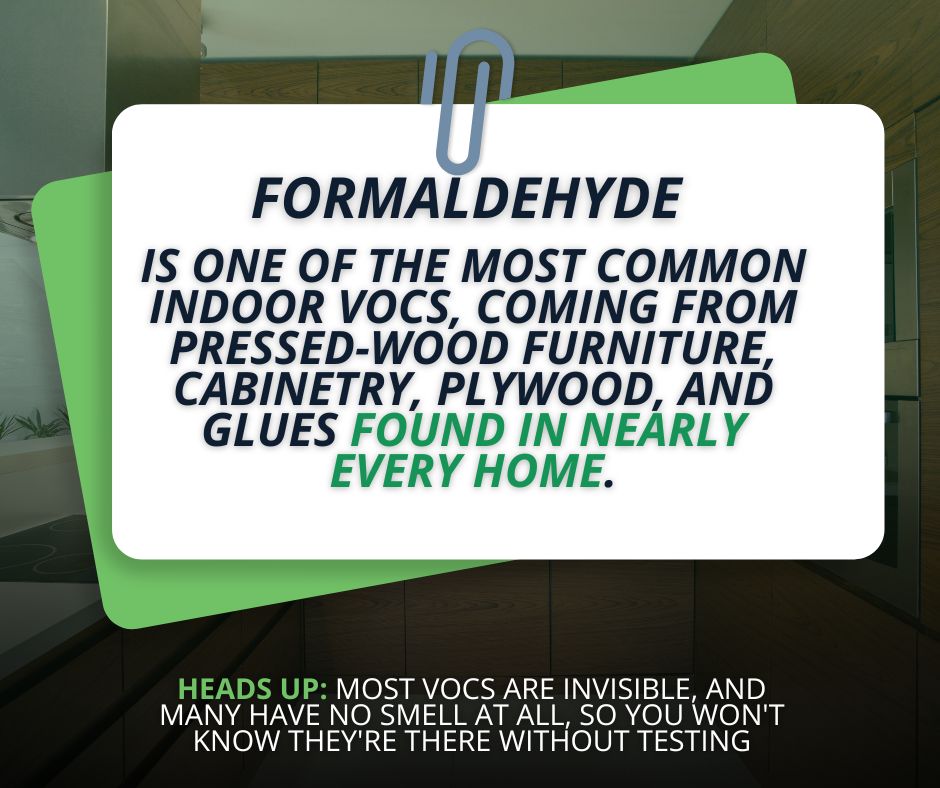
Formaldehyde deserves a special mention because it is one of the most common indoor VOCs and turns up in so many building materials and household goods. We cover it in depth in our guide to the sources of formaldehyde in your home.
Where VOCs Come From: Everyday Sources
Beyond specific chemicals, it helps to know the categories of things that release VOCs, because that is where prevention starts:
- Building materials and furnishings: new cabinetry, flooring, carpet, and pressed-wood furniture off-gas the most when new.
- Paints, finishes, and solvents: and the open containers stored in a garage or utility closet.
- Cleaning and personal care products: disinfectants, glass cleaners, aerosols, and some cosmetics.
- Combustion sources: tobacco smoke, wood or kerosene burning, and gas stoves.
- Hobby and craft supplies: glues, markers, and spray products.
This is also why a brand-new home or a fresh remodel can have noticeably higher VOC levels for a while. All those new materials are off-gassing at once.
Health Effects of VOC Exposure
How VOCs affect you depends on which compound it is, how concentrated it is, and how long you are exposed.
Short-term exposure to higher levels can cause headaches, dizziness, light-headedness, nausea, and irritation of the eyes, nose, throat, and lungs. These symptoms usually ease once you are away from the source or the room is aired out.
Long-term or repeated exposure is the bigger concern. It has been associated with neurological effects and liver and kidney damage, and a few VOCs, including formaldehyde and benzene, are linked to cancer. Children, older adults, and people with asthma or other respiratory conditions tend to be the most sensitive, which is why unexplained symptoms that improve when you leave the house are worth paying attention to.
How to Reduce VOCs in Your Home
You cannot eliminate VOCs entirely, but you can bring levels down with a few habits:
- Choose low-VOC or VOC-free options for paints, finishes, and cleaners. Look for it on the label.
- Buy only what you need. Stored solvents and half-used cans keep off-gassing for years.
- Store chemicals outside living space, ideally a detached garage or shed rather than a closet.
- Ventilate while you work. Open windows and run exhaust fans when painting, cleaning, or using aerosols.
- Air out new items. Let new furniture, carpet, or cabinetry off-gas in a garage or well-ventilated room before daily use.
- Dispose of old chemicals through your local household hazardous waste program instead of letting them linger.
How to Know If You Have a VOC Problem
Here is the tricky part: many VOCs are invisible, and while some have a noticeable odor (that “new” smell, a chemical or sweet scent), plenty are hard to detect, and your nose stops noticing a smell you live with. A lingering chemical odor, symptoms that clear up when you leave home, or a recent remodel are all reasons to look closer.
The only way to know what is actually in your air, and at what levels, is to measure it. Professional VOC testing samples your indoor air and identifies what is present, and a broader indoor air quality assessment can look at VOCs alongside other concerns like mold, particulates, and humidity. If you want the whole picture of your home’s environment, our Healthy Home Package bundles those assessments together.
Older or newly built homes carry their own considerations. A brand-new build, for example, is worth checking as materials finish off-gassing, which pairs well with a broader new-home walkthrough. VOCs are also just one of several hidden home hazards worth knowing about, alongside things like asbestos in older materials.
Related Questions to Explore
What are the most common VOCs in a home? Formaldehyde, benzene, toluene, xylene, acetone, and methylene chloride are among the most common, released by building materials, paints, cleaners, and personal care products.
Can you smell VOCs? Sometimes. Some VOCs have a clear chemical or “new” smell, but many are faint or odorless, and people quickly stop noticing a smell they live around. A missing odor does not mean the air is clear.
Are VOCs dangerous? It depends on the compound, the level, and how long you are exposed. Short-term effects are usually irritation and headaches, while long-term exposure to certain VOCs like formaldehyde and benzene carries more serious risks.
How do I get rid of VOCs in my home? Reduce the source (low-VOC products, proper storage, disposal), ventilate well, and air out new materials. Testing tells you whether your efforts are working.
Do air purifiers remove VOCs? Only certain ones. Filters with activated carbon can capture some VOCs, but a standard HEPA filter alone does not, since HEPA targets particles, not gases.
When to Call a Professional
Consider professional VOC or indoor air quality testing when:
- You notice a persistent chemical or “new” smell that will not clear
- Someone in the home has headaches, irritation, or respiratory symptoms that improve when they leave
- You recently remodeled, painted, or moved into a new build
- You have combustion appliances or an attached garage and want peace of mind
- You want to confirm whether source control and ventilation have actually lowered your levels
A certified assessment measures what a nose and a guess cannot, and gives you a clear report and next steps. Elite Mold Services has served Central Florida since 2006 with state-licensed, certified inspectors.
Conclusion
VOCs are an everyday part of modern homes, but that does not mean you are powerless. Knowing where they come from, choosing lower-VOC products, and ventilating well go a long way, and when you want real answers about your indoor air, it can be tested.
If a lingering odor or unexplained symptoms have you wondering what you are breathing, Elite Mold Services can help.
Schedule an indoor air quality assessment and get calm, lab-backed answers.