


DIY mold test kits are often marketed as a quick, affordable way to understand what is happening inside a home. For homeowners worried about health, odors, or visible growth, that promise can be hard to resist.
However, the problem is that mold does not work in simple terms. A test result without context rarely answers the questions homeowners actually have. In many cases, at-home kits create more confusion than clarity, especially in Central Florida, where moisture conditions make mold behavior more complex.
This guide explains why DIY mold test kits are unreliable, what they fail to measure, and why professional mold inspections provide clearer, safer answers.
What DIY Mold Test Kits Are Attempting to Do
Most DIY mold test kits are designed to confirm one thing only: that mold spores exist in the environment. They are not diagnostic tools, and they are not designed to identify the cause or severity of a mold problem.
Typical DIY kits fall into a few categories:
- Open-air petri dishes meant to capture airborne spores
- Surface swabs are used on visible areas
- Mail-in lab kits that return basic species lists
At best, these tools can show that mold spores are present. What they cannot do is explain whether those spores are coming from an active indoor source, whether moisture is feeding growth, or whether the conditions inside the home are abnormal.
This limitation is where most homeowner confusion begins.
Mold Is Everywhere, Even in Homes Without Mold Problems
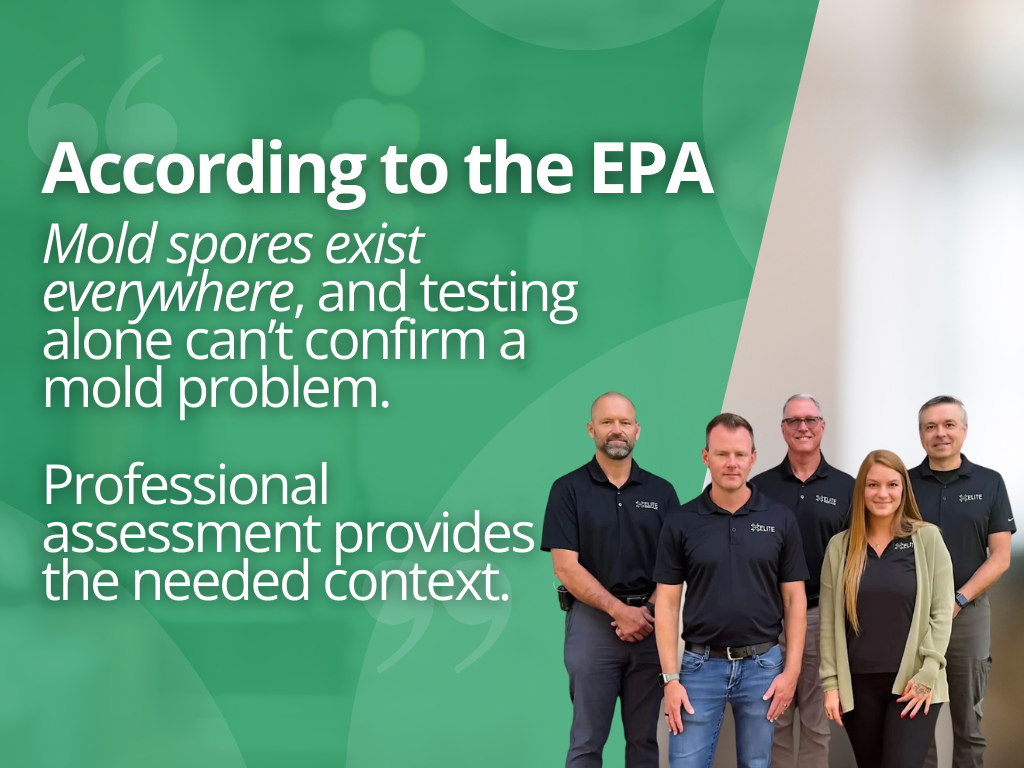
For example, one of the most misunderstood aspects of mold is that it is a normal part of the environment. Mold spores are present indoors and outdoors at all times.
The Environmental Protection Agency states that mold spores exist everywhere and that testing alone cannot determine whether a home has a mold problem. What matters is whether indoor conditions allow mold to grow.
As a result, DIY kits often produce positive results because spores are naturally present. Without outdoor comparison samples, moisture data, or building context, homeowners are left with results that sound alarming but may be completely normal.
This is one of the biggest reasons DIY mold test kits are unreliable for decision-making.
Why DIY Mold Test Results Are Frequently Misleading
DIY mold kits often produce results that are technically accurate but practically useless. The lack of context makes interpretation difficult, even for professionals, let alone homeowners.
Common misleading scenarios include:
- A positive result that reflects normal background spores
- A negative result despite hidden mold growth behindthe walls
- Results influenced by open windows, weather, or HVAC operation
- Lab reports listing mold types without explaining relevance
Without understanding moisture patterns, airflow, or building design, test results alone do not tell homeowners whether action is needed or what that action should be.
This is where professional interpretation makes a meaningful difference.
DIY Mold Test Kits Do Not Identify Moisture Sources
Mold growth does not occur without moisture. Testing for mold without identifying moisture is incomplete by design.
DIY kits do not evaluate:
- Active plumbing leaks
- Roof or window intrusion
- Elevated indoor humidity
- Condensation inside wall cavities or HVAC systems
Professional mold inspections focus on moisture first because eliminating moisture is the only way to prevent mold from returning. Elite Mold Services uses moisture meters, thermal imaging, and building assessments to identify conditions that support mold growth, something DIY kits cannot do.
Air Sampling Without Controls Creates Unreliable Results
Air sampling is one of the most misunderstood parts of mold testing. DIY kits often rely on uncontrolled air collection methods that do not account for environmental variables.
Airborne mold levels fluctuate based on:
- Outdoor spore counts
- Recent rain or humidity changes
- HVAC cycling
- Cleaning activity or foot traffic
Professional inspections use controlled sampling protocols and comparison data to determine whether indoor levels are elevated. DIY kits provide no such controls, making results inconsistent and difficult to trust.
Surface Testing Only Tells You What You Can Already See
Surface swab kits test visible areas, but mold problems are often hidden.
Swab testing does not reveal:
- Mold inside wall cavities
- Growth under flooring or cabinets
- Contamination within insulation
- Mold inside air handling systems
This limitation can give homeowners a false sense of security when deeper problems exist. Elite Mold Services frequently finds mold growth in areas that surface tests would never detect.
Why Mold Species Alone Do Not Determine Risk
DIY kits often emphasize identifying mold species, which can distract from more important factors.
Health and structural risk depend more on:
- How much mold is present
- Where it is growing
- Whether moisture is ongoing
- How occupants are exposed
The Centers for Disease Control notes that mold exposure risk is related to the extent and duration of exposure, not just species. Professional inspections evaluate these conditions rather than relying solely on lab results.
Central Florida Homes Face Unique Mold Challenges
Central Florida’s climate creates ideal conditions for mold growth. High humidity, frequent storms, and warm temperatures allow moisture problems to develop quickly and persist.
Common regional contributors include:
- HVAC condensation and drain line issues
- Attic moisture buildup
- Plumbing leaks hidden inside walls
- Flooding or storm-related water intrusion
DIY mold test kits do not account for these environmental realities. Elite Mold Services approaches mold evaluation with a Central Florida-specific understanding of how homes behave in this climate.
DIY Mold Test Kits Often Delay Proper Action
One of the most significant risks of relying on a DIY kit is delay. Homeowners may wait for results, misinterpret findings, or attempt surface cleaning instead of addressing the root cause.
Delays allow:
- Mold growth to spread
- Building material deterioration
- Indoor air quality declines
Early professional assessment helps prevent minor issues from turning into extensive remediation projects.
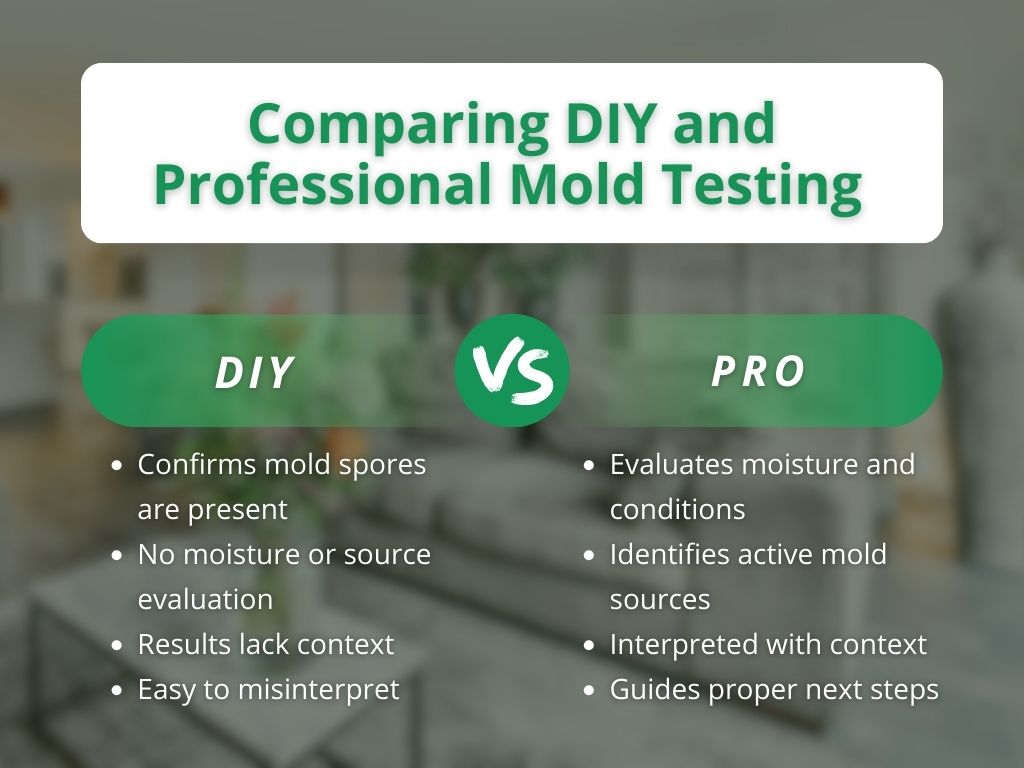
DIY Mold Test Kits vs Professional Mold Inspections
The table below highlights why testing alone is not enough.
| Evaluation Area | DIY Mold Test Kit | Professional Mold Inspection |
| Identifies moisture sources | No | Yes |
| Evaluates building conditions | No | Yes |
| Uses controlled sampling | No | Yes |
| Interprets results in context | No | Yes |
| Guides remediation decisions | Limited | Yes |
This difference is why Elite Mold Services emphasizes inspection first, testing second.
When True Mold Testing Makes Sense
Testing can be valuable when it is used strategically and interpreted professionally.
Mostly, it’s useful when:
- Moisture issues have been identified
- Results will guide remediation scope
- Post-remediation verification is needed
Testing without inspection rarely answers the questions homeowners are trying to solve.
Understanding Advanced Mold Testing Options
In some cases, more advanced testing methods are appropriate, but only when guided by a professional inspection.
EMMA testing looks for both mold spores and mold-related compounds called mycotoxins. It is sometimes used when health symptoms persist, and standard testing does not explain what occupants are experiencing.
ERMI testing analyzes household dust to understand long-term mold exposure. Because dust accumulates over time, this method can help identify whether a home has had ongoing mold conditions rather than a short-term issue.
These tests can provide helpful insight, but they do not locate moisture problems or active mold growth on their own. Results must be interpreted alongside building conditions, moisture data, and inspection findings.
Elite Mold Services uses advanced testing selectively, only when it adds clarity. The goal is to answer real questions, not create unnecessary concern from raw data alone.
The Elite Mold Services Approach
The team at Elite Mold Services provides comprehensive mold inspections, testing, remediation oversight, and post-remediation verification. The goal is not just to detect mold, but to understand why it exists and how to resolve it safely.
Their approach includes:
- Thorough visual and moisture inspections
- Targeted, defensible testing when appropriate
- Clear explanations in plain language
- Verification that remediation was successful
This full-scope approach gives homeowners reliable information they can act on with confidence.
When to Call a Mold Professional
Essentially, Homeowners should contact a professional mold inspector when:
- Musty odors persist
- Mold returns after cleaning
- Water damage has occurred
- Indoor humidity stays elevated
- Health symptoms raise concern
Elite Mold Services helps homeowners understand the full picture before deciding on the next steps.
Related FAQs to Explore
Why does mold return after cleaning?
Recurring mold usually means moisture was not addressed.
Can mold grow without visible water damage?
Yes. High humidity and condensation can support growth.
Does mold always affect indoor air quality?
Hidden growth and airflow patterns influence exposure risk.
Is professional testing always required?
Testing is situational and should support inspection findings.
Conclusion
DIY mold test kits may seem convenient, but they rarely provide meaningful answers. Without moisture evaluation, controlled sampling, and professional interpretation, results are often misleading.
In Central Florida, mold problems are tied to moisture, not test kits. Professional inspections provide the clarity homeowners need to protect their property and indoor air quality. Get in touch with the Elite team today.